Doctoral Thesis:
Survival Under Extremes: Human, Environmental, and Material Relationships Amidst the Soviet Famines in Ukraine. Queen’s University in Kingston. Theses. 2024.
Candidate of Science Thesis:
Trade in Kharkiv in the Years of NEP (1921–1929). [Torhivlya v Xarkovi v roky NEPu (1921–1929]. Kharkiv: V.N. Karazin Kharkiv National University, 2013. 252 p., 8 ill. (Ukr.)
Books:
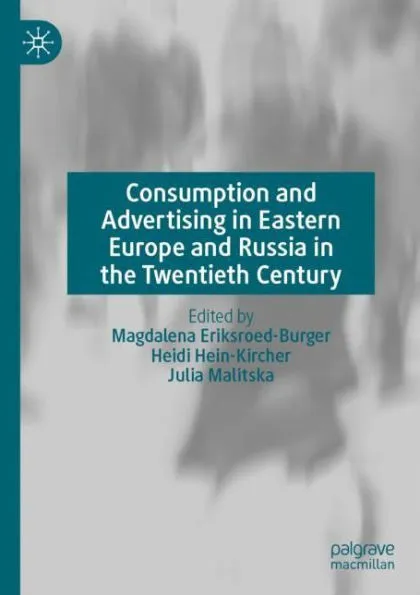
“Early Soviet Consumption as a First “Battle” on the Cultural Front.” In Consumption and Advertising in Eastern Europe and Russia in the Twentieth Century, ed. by Heidi Hein-Kircher, Magdalena Eriksroed-Burger, and Julia Malitska. (Palgrave Macmillan, 2023).
[…] the chapter will analyse how elite commodities, such as chocolate and furs, were “seen” by the early Soviet ideology and how this view was represented in commercial and state advertisements in the 1920–1930s. Being seen initially as a major representation of anticommunist behaviour, by the mid-1930s, both of these wares became non-inherent signs of Soviet modernity, prosperity, and abundance. As the emergence of the so-called “world of Soviet goods” took a non-linear path, from rejection to adoption, and, later, from adoption to appropriation, this study will uncover the logic behind the advertisement of elite goods in the early Soviet period and provide explanations as to why the early Soviet cultural “battle” failed.
“We Did Not Shrink From Eating Carrion:” Food Disgust And Early Soviet Famines. In Cultural Approaches to Disgust and the Visceral, ed. by Max Ryynänen, Heidi S. Kosonen, and Susanne C. Ylönen, 119-130. (New York: Routledge, 2022) (with Rebecca Manley).
This chapter addresses the problem of disgust from the vantage point of social history and famine and food studies. Focusing on the early Soviet famines of 1918-1919, 1921-1923, and 1932-33, it explores the impact of famine on food choices, taste, and cultural norms. In each of these famines, extreme conditions compelled people to consume substances that were spoiled, inedible, or simply taboo. In desperation, people turned to wild plants, diseased animals, pets such as dogs and cats, and, in the most extreme cases, human flesh.
Order here.
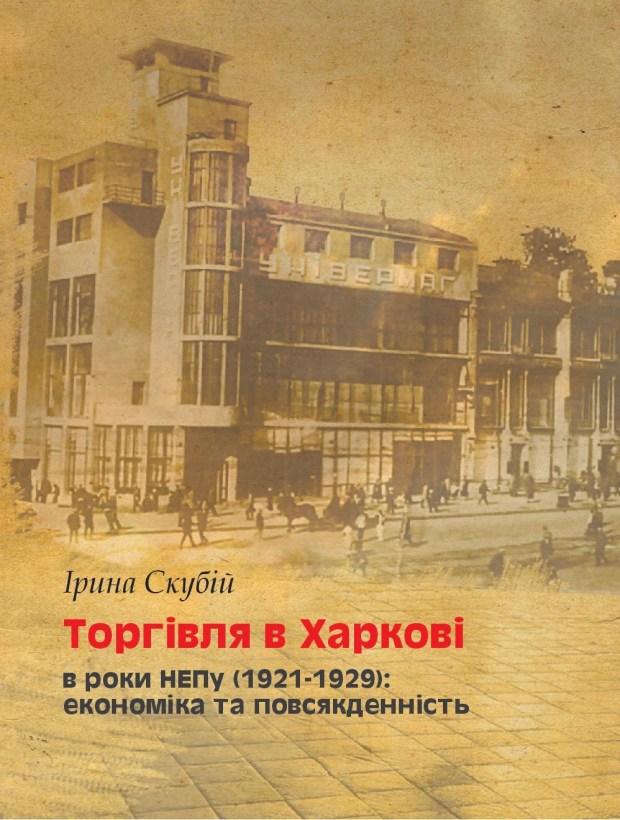
Trade in Kharkiv in the Years of NEP (1921–1929): Economy and Everyday Life. [Torhivlya v Xarkovi v roky NEPu (1921–1929): ekonomika ta povsyakdennist’]. (Kharkiv: Rarytety Ukrainy, 2017).
To obtain copies, please contact me.
Peer-reviewed articles and essays (selected):
“Food Waste and Survival in Times of Soviet Famines in Ukraine.” Journal of Contemporary History. Special Issue: Waste Management, ed. by Iris Borowy and Viktor Pal) (2023).
This article focuses on the interconnections and interrelations between food, waste, people and state during a series of survival crises in the famines of 1921–3, 1932–3 and 1946–7 in Soviet Ukraine. Owing to grain and food requisitions, the collectivization of agriculture and rationing, as part of the state’s growing control over the flow of economic resources from the 1920s to the 1940s, discarded food acquired particular importance for people’s survival during these times of extremes. Focusing on both individual and institutional levels of waste production and regulation, this study explores the role of food waste in the survival practices of the starving and traces the development of their individual resourcefulness and interconnectedness with wider social and natural environments. The article explores different types of food waste, including husks, leftover food, carrion and spoiled and rotten food and the spaces of its collection. By ‘following’ the traces of waste in urban and rural landscapes, including, among others, dumpsters, slaughterhouses, cattle cemeteries and railway stations, the article brings into focus the critical changes in human–food, human–waste and human–nature relationships in times of extremes.
Goods for the Smallest Citizens: Consumption, Spaces, and Material World of Toys in Early Soviet Ukraine. Childhood in the Past 14:1 (2021): 55–68.
This paper investigates toys and their consumer spaces as a part of the history of early Soviet childhood in Ukraine. Particular consideration is paid to the influence of communist ideology on determining a toy’s role in children’s upbringing. The study highlights the various spaces established in Ukraine for children’s collective consumption and the material world of play, such as the children’s branch of the central department store and the Palace of Pioneers.
Women Consumers in Urban Soviet Ukraine in The 1920–30s: Between Ideology and Everyday Life. History of Retailing and Consumption 6:1 (2020): 30–44.
Bogactwo w Czasach Radzieckich: Wymiar Materialny Życia Ukraińskiej Elity Ekonomicznej w Latach Dwudziestych i Trzydziestych XX Wieku [Weath in the Soviet times: material world of the Ukrainian economic elite in the 1920–1930s]. Res Historica 48 (2019): 193–213.
Universal Department Store as a Project Of Sovietization of the Urban Space and Consumption [Universal’nyi mahazyn yak proekt radyanizaciyi miskoho prostoru i spozhyvannia], Commons: Journal of Social Critics. Space and Inequality 12 (2019): 46–51.
Problem of the Trauma Understanding in Soviet Consumption in 1920–1930s [Problema rozuminnya travmy v radyans’komu spozhyvanni v 1920–1930-ti roky], Naukovi Zapysky National University Kyiv-Mohyla Academy. Historical Sciences 1 (2018): 67–72.
Online publications:
“Russia’s war in Ukraine has been devastating for animals – but they’ve also given the nation reason for hope.” The Conversation. 24 July, 2024.
“Famines in Soviet Ukraine. What We Still Need to Know.” IWMpost. Magazine of the Institut für die Wissenschaften vom Menschen. 130 Winter (2022): 10.
Writing about the Soviet famines in Ukraine and their legacies exposes the hierarchies and interconnections of human survival, environment, and materiality as the value of natural resources, animals, and material items grew exponentially during these extreme periods. As millions of people were dying of starvation and illnesses, so were their animals. Wild animals were caught by people en masse. At the same time, material valuables were lost as a result of being exchanged for food and confiscated.
Every Girl Wants to Look Beautiful: Beauty and Women Consumption in Early Soviet Ukraine [“Kozhniy divchyni khochet’sya odyahtysya harno ta modno:” krasa ta zhinoche spozhyvannya v rann’oradyans’kiy Ukrayini]. Ukraina Moderna. (2021). September 17.
Trade in Kharkiv in the Years of NEP (1921–1929): Economy and Everyday Life, Peripheral Histories? September 14, 2020.
Material World of Children in the Holodomor and What Saved Their Lives [Material’nyy svit ditey v roky Holodomoru ta shcho vryatuvalo yikhni zhyttya]. Holodomor Studies (2020), April 20.
Children are the Happiness of the Society under Construction: Children’s Goods in Soviet Ukraine. [Dity – tse radist suspilstva, shcho buduietsia: dytiachi tovary v radianskii Ukraini], Ukraina Moderna (2017), October 15.
Book reviews (selected):
Review of Lakhtikova, Anastasia; Brintlinger, Angela; Glushchenko, Irina, eds., Seasoned Socialism: Gender and Food in Late Soviet Everyday Life. H-Socialisms, H-Net Reviews. April 2020.
Stanislav Kulchytsky, The Famine of 1932–1933 in Ukraine: An Anatomy of the Holodomor. European History Quarterly, 50(1) (2020): 166–168.
Berta, Péter. 2019. Materializing difference: consumer culture, politics, and ethnicity among Romanian Roma. Toronto: University of Toronto Press. (‘Anthropological Horizon Series’). 390 pp. Hb.: $90.00. ISBN: 978‐1487500573. Social Anthropology 28 (2020): 186–188.
Geoffrey, Jones. Profits and Sustainability. A History of Green Entrepreneurship (Oxford, Oxford University Press, 2017). Ukraina Moderna 25 (2018): 289–295.
Mayhill, C. Fowler. Beau Monde. On Empire’s Edge: State and Stage in Soviet Ukraine (Toronto: University of Toronto Press, 2017). Ukraina Moderna 25 (2018): 344–351.
For more information on my publications, please see my profile here.
 Iryna Skubii